
2026 is being defined by capital reallocation. AI is compressing labor, shifting budgets, altering buyer diligence, and reshaping exit pathways. The result is not uniform growth across cybersecurity. Capital is flowing toward leverage, platform alignment, and measurable operational impact.
Below are ten structural forces shaping deal activity, valuation dispersion, and strategic positioning this year.
1. Operational Leverage Is Driving Premium Valuations
The market is no longer rewarding feature expansion or workflow complexity. It is rewarding operational compression. Companies that reduce headcount dependency, automate repetitive labor, and demonstrate measurable business impact are commanding stronger growth equity interest and higher EV per employee ratios.
Strategic acquirers are increasingly paying premiums for small, technically concentrated teams that can collapse years of product development into a single transaction. This is reflected in continued strength in high EV per employee transactions across AI-driven security assets. Expect continued premium valuations for companies that demonstrate defensible workflow ownership rather than broad but shallow product portfolios.
2. Security Spend Is Competing for Capital, Not Disappearing
Security budgets are not shrinking structurally, but they are now evaluated alongside AI initiatives. This creates capital tension inside enterprises. Security vendors that tie their value proposition to operational efficiency and cost avoidance are outperforming those selling incremental detection improvements.
Seat-based pricing models face margin pressure where AI reduces manual labor. Meanwhile, vendors that embed AI to lower customer operating costs are seeing stronger retention and multiple resilience. Growth equity and PE are prioritizing vendors with defensible pricing structures tied to outcomes, rather than seats.
3. Hyperscaler Gravity Is Reshaping the M&A Landscape
AI infrastructure leaders including OpenAI, Anthropic, AWS, and Google have been shaping the security stack for years through primitives and platform bundling. In 2026, that influence is becoming more direct. OpenAI’s Aardvark and Anthropic’s Claude Code Security are early signals of deeper integration into critical workflows. As AI-native workloads expand across identity, data access, and model governance, control over these layers becomes strategic.
This increases the likelihood of selective acquisitions and capital deployment by hyperscaler-aligned ecosystems. For the capital markets, startups that integrate natively into these AI stacks or solve governance and control challenges around them become higher-probability M&A targets and more strategic growth investments.
4. Diligence Depth Is Increasing as AI Enters Critical Workflows
The shift from Proof of Concept to Proof of Value is real, but PoC cycles are not shortening. They are becoming more rigorous. When AI systems touch regulated data, identity layers, or core operations, evaluation depth increases.
This elongates sales cycles for early-stage companies but strengthens defensibility for vendors that survive scrutiny. Investors are increasingly underwriting based on deployment durability and workflow stickiness.Companies that clear enterprise diligence barriers become more valuable acquisition targets and more defensible late-stage growth investments, which is what we have seen in the start of 2026.
5. Identity Platforms Continue to Attract Premiums
Identity remains the control plane for cloud and AI environments. As machine identities and AI agents proliferate, complexity increases. This expands the TAM for identity governance, session control, and continuous authentication.
Strategic buyers are actively consolidating identity-adjacent capabilities to increase wallet share while PE and VC-backed companies look to grow their customer base through add-ons. Identity-centric and agent-aware governance platforms remain among the most durable categories for M&A and platform consolidation.
6. AI Is Compressing SOC Labor Models and Increasing Platform Consolidation
Automation inside the SOC is not eliminating talent. It is shifting value toward higher judgment functions and reducing reliance on repetitive triage layers. This increases the attractiveness of AI-native SOC platforms and MDR providers that scale without linear headcount growth.
From a valuation perspective, investors are rewarding operating leverage and margin expansion driven by automation. SOC platforms that demonstrate AI-enabled margin improvement are attracting strategic and private equity interest.
7. AI Governance Is Emerging as a Standalone Investment Theme
Shadow AI and agent proliferation are creating visibility gaps that require centralized governance layers. Enterprises are formalizing AI control frameworks around access, monitoring, and policy enforcement.
This creates a consolidation opportunity across governance and compliance automation within AI ecosystems. Vendors positioned at the intersection of governance, compliance, and AI control are likely to see increased inbound M&A and growth equity attention.
8. Human-lead Companies (AKA Services) Will Remain the Most Active M&A Sector
Services and MSPs have been the most active segment in cybersecurity M&A over the past two years, and that momentum is going to continue through 2026. Enterprises spend roughly twice as much on cyber services as they do on security products, creating a larger revenue base and a deeper pool of acquisition targets. The market remains one of the most fragmented, with many bootstrapped and regionally focused MSPs available for consolidation.
PE continues to favor this segment due to predictable recurring revenue, EBITDA, and straightforward integration dynamics. While AI is improving margins and operating efficiency, it is not materially reducing demand for human-led services in 2026. Given the 2:1 spending mix, fragmented supply, and durable roll-up economics, services are positioned to remain the most active sector in cybersecurity M&A through 2026.
9. Strategic Exits Are Outpacing IPO Pathways
Public market selectivity remains high. Despite a backlog of IPO-capable vendors, acquisition remains the more probable liquidity event for many companies. Strategic buyers are pursuing capabilities to defend platform positions and expand market share.
PE remains active as an alternative liquidity path as well, particularly in durable sectors of Cybersecurity like Security Services and GRC. The dominant exit vector continues to be strategic consolidation rather than public listing. Late-stage companies increasingly optimize toward strategic fit and platform alignment rather than standalone IPO narratives.
10. AI Economics Are Becoming a Core Diligence Variable
AI cost structure is now a board-level discussion. Token costs, model routing efficiency, and compute discipline directly influence gross margins and customer retention. Buyers are scrutinizing total cost of ownership and model efficiency as part of vendor evaluation.
Vendors that demonstrate efficient AI deployment and scalable economics are separating from competitors built on experimental integrations. AI efficiency and cost transparency are emerging as underwriting criteria in both M&A and growth financings, making M&A processes more selective.
2026 is a year of valuation dispersion. Capital is concentrating in companies that align with platform gravity, automate labor, defend margins, and survive deeper enterprise diligence. The market is not rewarding novelty. It is rewarding leverage.
Understanding the Cybersecurity Landscape in 2026
The ten trends above represent how capital markets are interpreting structural shifts inside the cybersecurity industry. But the operational context underneath those capital flows matters just as much. For enterprises, security teams, and cybersecurity professionals making investment and vendor decisions, the threat landscape in 2026 is defined by a set of compounding forces: AI adoption, identity proliferation, cloud complexity, and an evolving regulatory environment. What follows is a practitioner-level read on the major themes shaping security operations, M&A, and vendor strategy this year.
AI Is Both the Biggest Tool and the Biggest Attack Surface
Artificial intelligence is now embedded across security operations, threat detection, and vendor product development. Security teams are using AI to accelerate triage, reduce manual workload, and improve response times. At the same time, AI systems themselves have become a critical attack surface. Threat actors are probing AI tools, manipulating model inputs, and attempting to evade detection through methods that conventional security controls were not designed to catch.
The asymmetry is significant. AI tools lower the operational cost of launching sophisticated attacks, which means that threat actors no longer need large teams or specialized expertise to execute phishing attacks, generate synthetic credentials, or probe API security vulnerabilities at scale. Meanwhile, defenders are absorbing the same AI efficiency gains but face the additional burden of securing AI systems themselves.
Machine learning models are increasingly deployed in production environments that touch sensitive data, financial transactions, and regulated workflows. This creates a new category of security risk that sits at the intersection of data governance, access management, and model integrity. Vendors building controls around AI systems are positioning themselves directly in front of this demand, which is part of why AI governance is emerging as a standalone investment theme rather than a feature inside existing platforms.
For security teams evaluating tooling in 2026, the relevant question is not whether a vendor has AI capabilities. Most do. The relevant question is whether the vendor can demonstrate AI governance, model transparency, and cost-efficient deployment. AI economics are becoming a core diligence variable on both sides of the table.
Identity Is the New Perimeter, and the Problem Is Getting Harder
Identity security has been the defining theme in cybersecurity M&A for several years. In 2026, the complexity is accelerating, not stabilizing. The expansion of machine identities and AI agents means that identity and access management is no longer a human-centric problem. Every autonomous agent, service account, and API integration represents an identity that needs to be governed, monitored, and controlled.
Zero trust frameworks are the architectural response to this shift. The principle of never trust, always verify was designed for a world where perimeters had dissolved. In 2026, it is increasingly being applied to AI agents and automated workflows, not just human users. Identity first security, which centers identity verification and continuous authentication at every access decision, is gaining traction as organizations realize that perimeter-based models offer no protection once an attacker has valid credentials.
The operational challenge is multi-factor authentication fatigue and credential sprawl. As enterprises scale AI agents across cloud environments, each interaction creates an authentication event. Managing identity controls across this surface requires continuous monitoring, behavioral analytics, and centralized policy enforcement. Organizations that have not modernized their identity infrastructure face significant exposure, particularly as insider threats and adversary tactics increasingly involve credential abuse rather than perimeter intrusion.
Zero trust adoption is also driving M&A. Strategic buyers are acquiring identity-adjacent capabilities to extend platform coverage and increase wallet share. Identity management vendors that can demonstrate native integration with AI environments are commanding premium valuations, consistent with what we described in Trend 5 above.
Cloud Environments Are Expanding the Attack Surface
Cloud security posture management has become a baseline capability rather than a premium add-on. The scale of misconfiguration-driven breaches has made cloud environments one of the primary sources of data breaches across every industry vertical.
The challenge in 2026 is not simply securing cloud infrastructure. It is securing the intersection of cloud environments, AI workloads, and distributed access patterns. API security has emerged as a critical gap. As organizations build more services on cloud-native architectures, API attack surfaces grow in proportion. Threat actors are exploiting insecure APIs to access sensitive data, bypass authentication, and move laterally across cloud environments.
Cloud security posture management tools are evolving to address this, incorporating real-time policy enforcement, continuous monitoring, and integration with identity and access management platforms. Vendors that bridge cloud security, identity, and data protection into a unified view are attracting both enterprise buyers and strategic acquirers.
The services layer around cloud security is also growing. Cloud security requires configuration expertise, continuous monitoring, and operational support that many enterprises cannot build in-house. This is part of why security operations and managed services remain among the most active M&A segments in 2026, as we noted in Trend 8.
Threat Detection and Response Is Being Rebuilt Around AI
Traditional SOC models were built around human analysts processing alerts at scale. AI is changing this model in two ways: it is reducing the volume of low-fidelity alerts that require human review, and it is raising the baseline capability required to handle the alerts that remain.
Threat detection has become more sophisticated as AI tools enable richer behavioral analytics, faster correlation across data sources, and more accurate anomaly detection. Advanced threat hunting capabilities are being built on top of these foundations, enabling security teams to pursue threat actors proactively rather than reactively.
The shift matters for vendor positioning. SOC platforms that can demonstrate AI-enabled margin improvement and reduced analyst fatigue are attracting premium valuations. MDR providers that scale without linear headcount growth are positioned as operational leverage plays for PE and growth equity investors. The story is not AI replacing cybersecurity professionals. It is AI enabling smaller, more capable security teams to protect larger environments.
Phishing attacks remain the most common entry vector for data breaches, and AI has made them significantly harder to detect. Sophisticated phishing campaigns now use AI-generated content, synthetic voice, and contextual personalization that bypasses conventional filters. Security measures that rely on static signatures or rule-based detection are increasingly insufficient.
Threat actors are also becoming more systematic about attack surfaces. Rather than targeting specific systems opportunistically, they are mapping the full topology of an organization’s exposure before engaging, including cloud environments, third-party integrations, API endpoints, and identity systems. Security teams that are not doing the same thing internally are operating at a structural disadvantage.
Data Protection Is Back at the Center of the Conversation
Data breaches remain the most financially damaging category of cyber incident, and the volume has not declined despite significant security investment. The reason is that the attack surface for sensitive data keeps expanding. AI tools ingest proprietary data. Cloud services store regulated information. Third-party integrations create data leaks through access patterns that are difficult to audit.
Regulatory scrutiny around data protection has increased across multiple jurisdictions. Enterprises are now building data governance frameworks that span cloud environments, AI workflows, and partner integrations. This is creating demand for data classification, access management, and continuous monitoring tools that can operate at scale across distributed environments.
Protecting sensitive data is no longer just a compliance objective. It is a board-level risk management priority. The financial and reputational consequences of a material data breach in 2026 are significant enough that boards are asking different questions: not whether they have a data protection policy, but whether they have operational visibility into where sensitive data lives and who can access it.
Data breaches also have downstream effects on M&A. Buyers conducting diligence on acquisition targets are increasingly scrutinizing data protection practices, incident history, and regulatory exposure. Target companies with weak data governance frameworks face valuation discounts or deal-breaking findings during the diligence process. Clean data practices are a competitive asset in a transaction.
AI Governance Is Moving from Concept to Infrastructure
Shadow AI, which refers to AI tools deployed within organizations without formal approval or monitoring, has become a governance challenge for security teams. Employees are using AI tools to process internal documents, automate workflows, and generate outputs that may touch regulated or proprietary information. Without visibility into how AI tools are being used, security teams cannot enforce policy or identify risk.
AI governance frameworks are emerging in response. These frameworks address access management for AI systems, continuous monitoring of model inputs and outputs, audit logging, and policy enforcement. Vendors building these capabilities are addressing a gap that existing security tooling was not designed to fill.
The governance challenge extends to AI agents operating autonomously inside enterprise environments. Agentic workflows create new questions around authorization, accountability, and auditability. As AI agents proliferate, identity and access management systems need to extend to cover non-human principals at scale.
This is why AI governance has moved from a theoretical concern to an active investment theme in 2026. The gap between AI deployment velocity and governance maturity is large enough that enterprises are actively buying solutions rather than building them. Vendors that can demonstrate deployment-ready governance capabilities, rather than roadmap features, are capturing disproportionate attention from both enterprise buyers and investors.
Regulatory frameworks around AI governance are also developing. Enterprises facing regulatory scrutiny around AI use are motivated to invest in governance tooling ahead of enforcement actions. This combination of operational demand and regulatory pressure is creating durable, defensible revenue for vendors in this segment.
The Cybersecurity Workforce Continues to Expand Its Scope
Cybersecurity professionals in 2026 are being asked to understand AI systems, govern cloud environments, manage machine identities, and operate in threat landscapes that change faster than training programs can keep pace with. The skills gap has not closed. It has shifted.
The shortage of qualified security professionals continues to drive demand for managed services, automated tooling, and security operations platforms that reduce reliance on specialist headcount. MSPs and MSSPs that can deliver security outcomes without requiring enterprises to staff deep in-house teams are serving a fundamental market need. This is a core driver of the service sector M&A activity we highlighted in Trend 8.
Cybersecurity workforce development is also becoming a strategic consideration for acquisitions. Companies with strong talent density in AI security, cloud security, or identity governance are attractive not just for their products but for their teams. Acqui-hire dynamics are real, particularly as the market for AI-specialized security talent tightens.
For enterprises, constant communication between security leadership and the broader business has become essential. Security risks are no longer confined to IT. They affect revenue, operations, regulatory standing, and competitive positioning. Security teams that can articulate risk in business terms, and that maintain continuous dialogue with executive leadership, are better positioned to secure budget and organizational support.
Emerging Threats and Evolving Risks Require Continuous Adaptation
The threat landscape does not pause while organizations build their security programs. Evolving threats, including AI-generated attacks, quantum computing implications, insider threats from credential abuse, and adversary tactics that combine multiple attack vectors, require security teams and vendors to maintain adaptive postures.
Quantum computing introduces a longer-horizon risk to encryption standards that is already influencing procurement decisions among regulated industries and national security-sensitive enterprises. While broad commercial quantum capability remains years away, the planning horizon for cryptographic infrastructure means that security teams need to begin addressing this now.
Insider threats continue to represent a significant share of material security incidents. The combination of credential sprawl, remote access patterns, and AI tools that amplify what a single user can access or exfiltrate has made insider risk more consequential. Behavioral analytics and continuous monitoring are the primary countermeasures, and vendors with strong capabilities in this area are seeing sustained demand.
Ethical hacking and red team operations remain a foundational component of mature security programs. As AI tools make it easier to simulate sophisticated attacks, enterprises are investing more in continuous adversarial testing rather than point-in-time penetration tests. Security controls that survive adversarial simulation are more defensible in vendor evaluations, regulatory examinations, and M&A diligence.
What This Means for Capital Markets
Each of these operational dynamics maps directly to capital flows. The cybersecurity categories attracting premium valuations and active M&A interest in 2026 share common characteristics: they address structural enterprise risk, they demonstrate AI integration that improves margins or outcomes, they survive rigorous enterprise diligence, and they occupy defensible positions in either the identity, data protection, or AI governance layers.
Cybersecurity M&A is not slowing down. It is becoming more precise. Buyers have clearer criteria. Investors are underwriting to more specific value drivers. The companies being acquired at premium multiples are not broadly positioned security platforms. They are companies with concentrated technical capability, operational leverage, and alignment with platform gravity.
For cybersecurity professionals, vendors, and investors trying to navigate 2026, the core message from both the capital markets and the operational landscape is the same: the premium is on leverage. Leverage over workflows, over identities, over AI environments, and over the threat vectors that matter most to enterprise buyers. That is where the market is concentrating, and that is where the capital is going.
Join us In Austin
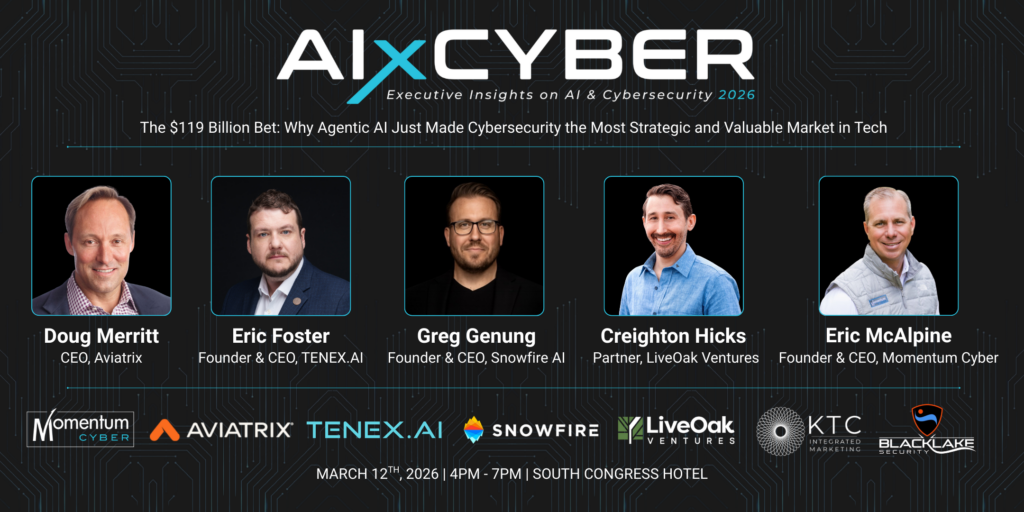
Join us in Austin for AIX Cyber, Momentum Cyber’s private gathering of cybersecurity founders, investors, and strategic buyers focused on how AI is reshaping the security landscape. We’ll explore capital flows, platform gravity, AI economics, and the structural forces driving M&A and valuation dispersion in 2026. If you’re building, buying, or backing cybersecurity companies, this is where the capital markets conversation is happening. Learn more: https://momentumcyber.com/aixcyber/
Author

Jake Pollock
Head of Research
Jake Pollock has extensive experience across cybersecurity and software investment banking and research. Prior to joining Momentum Cyber, he served as Head of Research at a boutique, middle-market investment bank focused on software M&A, where he led research efforts supporting transaction execution and client advisory. Earlier in his career, he was an analyst at Bain & Company.